
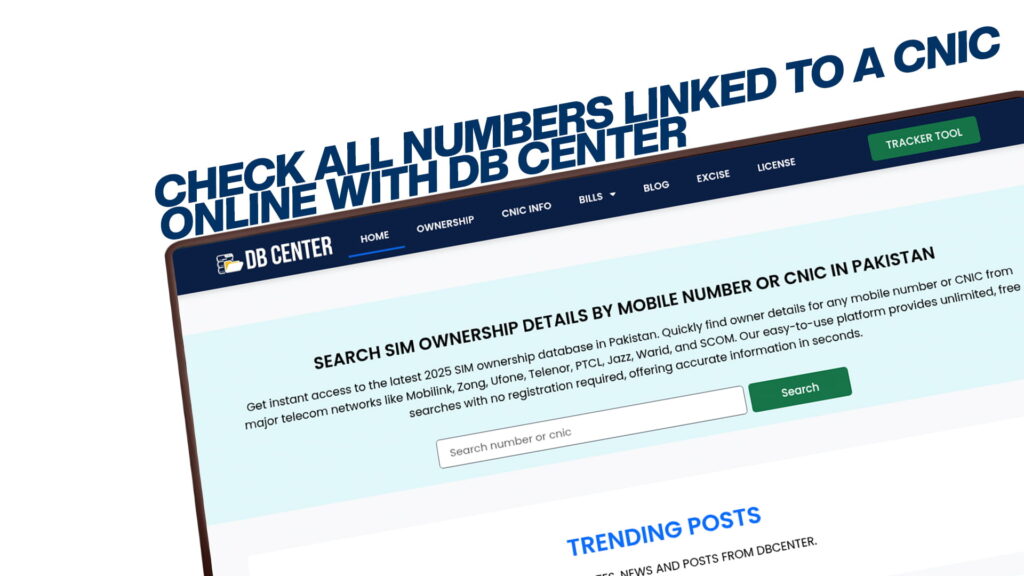
In today’s world, mobile phone numbers are not just a way to make calls. They are deeply connected to your identity, your bank accounts, your social media profiles, and even your government records. In Pakistan, every SIM card that is issued by any telecom company must be registered under a valid CNIC number. This means that every person who uses a mobile number in Pakistan has that number directly linked to their national identity. Because of this system, it has become very important for people to know exactly how many numbers are registered under their CNIC, who owns a particular number, and whether someone is misusing their identity to register SIM cards without their knowledge or consent.
DB Center is a powerful and easy-to-use online platform that gives every Pakistani user the ability to check all the mobile numbers linked to any CNIC. Whether you want to check numbers registered in your own name, investigate a suspicious number that has been calling you, or verify whether a person’s identity matches the SIM card they are using, DB Center provides all of this information in just a few seconds. The platform offers access to the latest 2026 SIM ownership database in Pakistan, which covers all major telecom networks operating in the country.
This article will walk you through everything you need to know about checking all numbers linked to a CNIC online using DB Center. You will understand what the platform is, how it works, why it matters, which networks are covered, and how this service protects you from identity theft and SIM fraud in Pakistan.
What Is DB Center and Why Does It Matter in Pakistan?
DB Center is an online information service that was created specifically for users in Pakistan who want to look up ownership details of mobile numbers. The platform has built a comprehensive and updated database that pulls together SIM ownership records from all the major telecom networks in Pakistan. When you enter a CNIC number or a mobile number into the search system, DB Center quickly scans through its database and brings back the ownership information associated with that identity or number.
The reason this service matters so much in Pakistan is because of the country’s mandatory SIM registration system. The Pakistan Telecommunication Authority, commonly known as the PTA, has made it compulsory for every SIM card to be biometrically verified and linked to a valid CNIC. This was done to improve national security, reduce crime, and ensure accountability in the telecom sector. However, despite this system being in place, there are still cases where people have SIM cards registered under their CNIC without their knowledge. Criminals sometimes steal CNIC details and register SIM cards in other people’s names, which can then be used for fraud, harassment, or other illegal activities.
Because of these threats, it has become critical for ordinary citizens to have access to a tool that allows them to check exactly which numbers are linked to their identity. DB Center fills this gap perfectly. It provides a fast, reliable, and accurate way to check SIM ownership details, and it supports lookups for every major telecom network in Pakistan including Mobilink, Jazz, Zong, Ufone, Telenor, PTCL, Warid, and SCOM. This makes it a one-stop solution for anyone looking to verify mobile number ownership in the country.
The SIM Registration System in Pakistan: A Background
To fully understand why DB Center is so valuable, it helps to understand how SIM registration works in Pakistan and why the government put this system in place in the first place. The PTA introduced mandatory biometric SIM verification back in 2015. Under this system, no new SIM card can be issued without fingerprint verification matched against the NADRA database. Every SIM that was already active at the time had to be re-verified as well, and millions of SIMs that could not be verified were blocked.
The idea behind this was straightforward. By linking every SIM card to a specific national identity, it would be much easier for law enforcement to track down criminals who use mobile phones to carry out illegal activities. Before this system was introduced, it was very easy for anyone to buy a SIM card without any form of identity verification, which made it extremely difficult for authorities to trace calls or identify the people behind criminal activities.
While the biometric verification system was a major step forward, it also created a new kind of problem. Because CNIC numbers are now so closely tied to SIM cards, the misuse of someone’s CNIC to register SIM cards without their consent has become a real threat. Identity theft in the telecom space is a growing issue in Pakistan, and many people have no idea that their CNIC has been used to register numbers they never bought. DB Center helps solve this problem by giving users the ability to check and monitor which numbers are registered under their identity at any given time.
How DB Center Works: The Technical Side Explained Simply
DB Center operates by maintaining a regularly updated database that contains SIM ownership records tied to CNICs and phone numbers across all major telecom networks in Pakistan. The platform sources this data from telecom network records and combines it into a single searchable system. When a user types in a CNIC number or a mobile number and hits the search button, the platform queries its database and returns the relevant ownership information in a matter of seconds.
The user interface of DB Center has been designed with simplicity in mind. You do not need to be tech-savvy to use it. The search process is clean and straightforward. You visit the platform, enter the information you are looking for, and the results appear almost immediately. There are no complicated forms to fill out, no lengthy verification processes to go through, and no waiting period for results. The platform is accessible from any device with an internet connection, whether that is a smartphone, a tablet, or a desktop computer.
The data returned by DB Center typically includes the name of the SIM card owner, the CNIC number linked to that SIM, the telecom network on which the number is registered, and sometimes additional contact or registration details depending on the type of search being performed. If you are searching by CNIC, the platform will display all the SIM cards that have been registered under that identity, giving you a full picture of which telecom numbers are linked to that national ID.
The database is updated regularly to ensure that the information reflects the most current SIM ownership records available. This is particularly important given that people buy, sell, and deactivate SIM cards frequently, and the database needs to stay current to be useful.
Which Telecom Networks Does DB Center Cover?
One of the strongest features of DB Center is that it does not limit itself to just one or two telecom operators. The platform covers all the major telecom networks that operate in Pakistan, which means that whether you are looking up a Jazz number, a Zong number, a Telenor number, or any other network, DB Center will have the information you need. Below is a breakdown of the networks covered and why each one matters.
Mobilink and Jazz are essentially the same network, with Jazz being the consumer brand of the Mobilink infrastructure. Jazz is currently the largest mobile network operator in Pakistan by subscriber count, which means a very large portion of the country’s active SIM cards are registered on this network. DB Center’s coverage of Jazz and Mobilink numbers means that users can look up the ownership details of the largest pool of mobile numbers in the country.
Zong is another major player in the Pakistani telecom sector and is particularly popular among users in urban areas and among younger demographics. Zong has one of the fastest growing subscriber bases in Pakistan and is also one of the leading providers of mobile data services. DB Center covers Zong numbers in full, allowing users to look up SIM ownership details for any Zong number they encounter.
Telenor is a well-established international telecom brand that has a strong presence in Pakistan. Telenor Pakistan has millions of subscribers and is known for its wide network coverage across the country. Whether a number begins with a Telenor prefix or was registered through Telenor’s outlets, DB Center can retrieve the ownership information for it.
Ufone is another important Pakistani telecom network, especially known for its coverage in rural and semi-urban areas. Ufone is owned by the PTCL group, which gives it deep roots in the country’s telecom infrastructure. DB Center supports full lookups for Ufone numbers, making it possible to verify the identity behind any Ufone SIM.
PTCL is the Pakistan Telecommunication Company Limited, which is the oldest and largest telecommunications provider in the country. PTCL provides both fixed-line and mobile services, and while its mobile division has been branded under other names over the years, the underlying infrastructure remains part of the PTCL network. DB Center includes PTCL numbers in its coverage.
Warid was a separate telecom network in Pakistan that was eventually merged into the Jazz network. However, because many numbers that originally belonged to Warid are still in active use and may still appear under Warid in older records, DB Center continues to maintain coverage for Warid numbers. This ensures that users can still trace ownership of older numbers that were originally registered under the Warid network.
SCOM, which stands for Special Communications Organization Mobile, is a telecom network that primarily serves the Azad Kashmir and Gilgit-Baltistan regions of Pakistan. SCOM was established to provide telecommunications services to areas that are harder to reach for commercial telecom operators. DB Center also includes SCOM numbers, making the platform truly comprehensive in its coverage of mobile numbers across Pakistan.
How to Check All Numbers Linked to a CNIC Using DB Center
The process of checking all numbers linked to a CNIC using DB Center is very simple and requires no technical expertise whatsoever. Here is a complete, step-by-step guide to help you through the process.
The first step is to open your internet browser on any device and navigate to DB Center. Once the website loads, you will be presented with a clean and easy-to-navigate interface. The homepage typically features a search bar or a lookup tool prominently displayed, making it immediately obvious what the platform is designed to do.
The second step is to locate the CNIC lookup section of the platform. DB Center allows users to perform two types of searches: a search by CNIC number to find all mobile numbers registered under that identity, and a search by mobile number to find the owner details of a specific phone number. For checking all numbers linked to a CNIC, you will want to use the CNIC-based search option.
The third step is to enter the CNIC number you want to search. Pakistani CNIC numbers follow a specific format, typically 13 digits without dashes. Enter the full CNIC number into the search field carefully and double-check that you have entered it correctly, as a single wrong digit will return incorrect or no results.
The fourth step is to initiate the search by clicking the search button or pressing enter. DB Center will then query its database for all SIM cards registered under that CNIC number. This process typically takes just a few seconds, after which the results will be displayed on your screen.
The fifth step is to review the results. The platform will display a list of all the mobile numbers that are currently or have been registered under the CNIC you entered. For each number, you will typically see the name associated with the registration, the telecom network, and the number itself. This gives you a complete picture of the SIM card ownership tied to that identity.
If you find numbers in the results that you do not recognize and you are searching your own CNIC, this could be a sign that someone has misused your identity to register SIM cards without your consent. In such cases, you should report the issue to the relevant telecom operator and to the PTA as soon as possible.
Why You Should Regularly Check Your CNIC for Linked Numbers
There are several compelling reasons why every Pakistani citizen should regularly check their CNIC number to see which mobile numbers are registered under it. The most important of these reasons relates to security and the prevention of identity-related fraud.
SIM card fraud is a real and growing problem in Pakistan. There have been numerous documented cases where criminals have obtained someone’s CNIC information and used it to register multiple SIM cards in that person’s name. These illegally registered SIM cards are then used for a wide range of criminal activities including financial scams, harassment, phishing, and even organized crime. The innocent person whose CNIC was misused often has no idea that any of this is happening until they encounter problems such as being contacted by law enforcement or having their phone services disrupted.
By checking your CNIC regularly using DB Center, you can stay on top of which numbers are registered in your name and quickly identify any that you did not personally register. Early detection of this kind of misuse is critical because the longer a fraudulently registered SIM remains active, the more damage it can cause. DB Center gives you the tool to catch this early and take action before the situation gets out of hand.
Another important reason to check your CNIC-linked numbers regularly is to ensure compliance with the PTA’s rules on SIM card ownership. The PTA has a limit on how many SIM cards a single person can register under one CNIC. If the limit has been reached through fraudulent registrations, you may be unable to register a new SIM in your own name when you need one. Knowing which numbers are linked to your CNIC helps you manage this effectively.
Employers and business owners also have good reasons to use DB Center. If you are vetting a potential employee and want to verify their identity or check whether the contact number they have provided matches their stated identity, DB Center can help you perform that verification quickly and reliably. This kind of due diligence can help businesses avoid being deceived or defrauded.
Parents who want to monitor the telecom activity connected to their household’s CNIC numbers can also benefit greatly from DB Center. Knowing which SIM cards are registered under your family’s CNIC records helps you maintain oversight and ensure that no unauthorized numbers are being used under your identity.
How DB Center Helps in Fighting SIM Fraud and Identity Theft
Identity theft through SIM card misuse is one of the most prevalent forms of digital fraud in Pakistan today. The consequences of having your CNIC used to register SIM cards without your consent can be severe. Not only can these fraudulently registered numbers be used to commit crimes that get traced back to your identity, but they can also be used to receive OTP codes for accessing your bank accounts, your social media profiles, and other sensitive services that rely on mobile number verification.
DB Center plays a critical role in helping ordinary citizens fight back against this kind of fraud. By providing instant access to SIM ownership records, the platform removes the information asymmetry that fraudsters rely on. When you can see exactly which numbers are linked to your CNIC at any time, you are in a much stronger position to detect and report misuse quickly.
The platform also helps individuals verify the identity behind unknown numbers that are calling them. If you receive a suspicious call from a number you do not recognize, you can use DB Center to look up the owner of that number. If the registered owner of the number does not match the person who is calling you, or if the number turns out to be linked to a suspicious identity, you can take that information to the appropriate authorities.
Law enforcement and security professionals also find tools like DB Center valuable in investigations. The ability to quickly determine who a mobile number belongs to, which CNIC it is registered under, and which network operates it can significantly speed up investigative work and help connect the dots in fraud or criminal cases.
It is worth noting that the responsible and ethical use of DB Center is important. The platform is intended to be used for legitimate purposes such as personal identity verification, fraud detection, and due diligence. Using the information provided by DB Center for harassment, stalking, or any other harmful purpose is strictly prohibited and illegal under Pakistani law.
The Role of the PTA and NADRA in SIM Verification
To fully appreciate what DB Center offers, it helps to understand the broader institutional framework within which SIM registration and verification operates in Pakistan. The two most important government bodies involved in this process are the PTA and NADRA.
NADRA, which stands for the National Database and Registration Authority, is the government body responsible for maintaining Pakistan’s national identity card system. Every Pakistani citizen’s CNIC is issued and managed by NADRA. The biometric data collected during CNIC issuance, including fingerprints and facial images, is stored in NADRA’s database and is used to verify identity for a wide range of purposes including SIM card registration.
The PTA is the regulatory authority responsible for overseeing the country’s telecom sector. The PTA sets the rules and standards that telecom operators must follow, including the rules around SIM card registration and biometric verification. The PTA has its own system for checking the number of SIMs registered against a CNIC, which is accessible through its official platform. However, the PTA’s official system has its limitations in terms of the depth and speed of information it provides to ordinary users.
DB Center builds on the foundation established by these government bodies and provides a more accessible and detailed information service. While DB Center is a third-party platform and not an official government service, it compiles data from the telecom networks in a way that makes it easy for any user to perform comprehensive lookups quickly. This fills an important gap that the official government systems do not always address effectively.
Differences Between Searching by CNIC and Searching by Mobile Number
DB Center supports two distinct types of searches, and understanding the difference between them helps users get the most out of the platform. The two search modes are: searching by CNIC to find all numbers linked to that identity, and searching by mobile number to find the owner details of a specific phone number.
When you search by CNIC, you are essentially asking the database to show you a complete list of all mobile numbers that have been registered under that national identity card number. This is particularly useful when you want to audit your own CNIC for unauthorized SIM registrations, or when you need to verify how many numbers a particular person has registered in their name. The result of a CNIC search is typically a list of multiple numbers, one for each SIM card that has been registered under that identity.
When you search by mobile number, you are asking the database to tell you who owns that particular phone number and under which CNIC it is registered. This type of search is useful when you have received a call or message from an unknown number and want to find out who it belongs to. It is also useful for businesses that receive inquiries from unfamiliar numbers and want to verify the identity of the person before engaging further. The result of a mobile number search typically includes the name of the registered owner and the CNIC under which the SIM is registered.
Both types of searches are available on DB Center and can be performed in seconds. The ability to switch between these two search modes makes DB Center a versatile tool that serves many different use cases within the broader context of SIM ownership verification in Pakistan.
Data Privacy and Responsible Use of DB Center
While DB Center provides an incredibly useful service, it is important to address the question of data privacy and responsible use. Every time personal data is made searchable online, there is a responsibility that comes with it, both for the platform providing the service and for the users who access it.
DB Center takes this responsibility seriously by ensuring that the data it provides is used within the bounds of what is legally and ethically acceptable in Pakistan. The platform is designed to help citizens protect themselves and verify identities for legitimate purposes. It is not designed to facilitate the invasion of anyone’s privacy or to enable harmful behavior.
As a user of DB Center, you also have a responsibility to use the information you obtain through the platform in a responsible and lawful manner. Looking up the details of a number that has been calling you, checking which numbers are registered under your own CNIC, or verifying the identity behind a business contact are all legitimate uses of the platform. Using the information to harass, stalk, intimidate, or harm another person is not only morally wrong but also a criminal offense under Pakistan’s electronic crimes laws, specifically the Prevention of Electronic Crimes Act, commonly known as PECA.
It is also worth being mindful of the fact that the information in any database can sometimes be outdated or incomplete. While DB Center strives to keep its data current and accurate, there may be instances where the information does not perfectly reflect the most recent state of SIM ownership. If you find information that seems incorrect or that you believe represents a misuse of your identity, you should verify through multiple channels including contacting your telecom operator and the PTA directly.
Why DB Center Stands Out from Other Lookup Tools
There are other tools and services available in Pakistan that offer some form of mobile number or CNIC lookup, but DB Center stands out for several important reasons.
The first reason is comprehensiveness. DB Center covers all major telecom networks in Pakistan in a single platform. Many other tools only cover one or two networks, which means you get an incomplete picture. With DB Center, you can be confident that your search results will reflect SIM cards across all networks.
The second reason is speed. DB Center delivers results almost instantly. You do not have to wait minutes or hours for a result. The fast performance of the platform means that you can perform multiple lookups quickly, which is particularly valuable when you need information in a hurry.
The third reason is the user experience. DB Center has been designed to be easy to use for everyone, regardless of their technical background. The interface is clean, the search process is straightforward, and the results are presented in a clear and readable format. You do not need any special training or expertise to use the platform effectively.
The fourth reason is data currency. DB Center updates its database regularly to ensure that the information it provides reflects the latest available SIM ownership records. This commitment to keeping data current is what sets DB Center apart from tools that rely on old or outdated datasets.
The fifth reason is the breadth of networks covered. By including not just the major commercial networks like Jazz, Zong, Telenor, and Ufone, but also PTCL, Warid, and SCOM, DB Center ensures that virtually every mobile number in Pakistan can be looked up through its system. This universal coverage is a significant advantage over competing platforms that focus only on the most popular networks.
Real-World Scenarios Where DB Center Proves Invaluable
To understand just how useful DB Center can be in everyday life, consider the following real-world scenarios that many people in Pakistan face on a regular basis.
A woman in Lahore receives multiple threatening calls from an unknown number. She does not recognize the number and is worried about her safety. By using DB Center to look up the number, she quickly finds out the name and CNIC of the person under whose identity the SIM is registered. She takes this information to the police, who are able to identify and locate the caller.
A businessman in Karachi wants to hire a new employee and asks them for their contact number during the interview process. He uses DB Center to verify that the number provided actually belongs to the person sitting in front of him. The lookup confirms that the number is registered under the same CNIC that the applicant presented, giving the businessman greater confidence in the applicant’s identity.
A man in Islamabad checks his CNIC on DB Center and discovers that five mobile numbers are listed under his identity but he has only ever purchased two SIM cards in his life. He immediately contacts the PTA and his telecom operators to report the three unauthorized numbers, preventing further potential misuse of his identity.
A parent in Peshawar uses DB Center to check which numbers are registered under the family’s CNICs to ensure that no one in the household has registered SIM cards without family knowledge. This helps the parent maintain oversight of the household’s telecom activities and prevents any undisclosed use.
Each of these scenarios illustrates the real, practical value that DB Center brings to users in Pakistan. The platform is not just a technical tool; it is a means by which ordinary citizens can protect themselves, their families, and their businesses from the growing threat of identity-related fraud in the digital age.
You can check all SIM cards registered under your CNIC by visiting DB Center, entering your 13-digit CNIC number in the search bar, and the platform will instantly display all mobile numbers linked to your national identity across all telecom networks including Jazz, Zong, Telenor, and Ufone.
Yes, DB Center allows you to search by mobile number to find the registered owner’s name and the CNIC under which that SIM was issued. This works for numbers registered on all major Pakistani telecom networks including Mobilink, Telenor, Zong, Ufone, PTCL, Warid, and SCOM.
If DB Center shows a mobile number registered under your CNIC that you never purchased, you should immediately contact the relevant telecom operator to report the unauthorized registration, and also file a complaint with the PTA through their official complaint portal to have the fraudulent SIM blocked and removed from your identity.
Using DB Center for legitimate purposes such as verifying your own CNIC-linked numbers, checking an unknown caller’s identity, or performing business due diligence is fully legal. However, using the information obtained for harassment, stalking, or any harmful intent is a criminal offense under Pakistan’s Prevention of Electronic Crimes Act (PECA).
According to PTA regulations, a maximum of five SIM cards can be registered under a single CNIC in Pakistan across all telecom networks combined. DB Center helps you monitor this limit by showing you exactly how many and which numbers are currently linked to your CNIC, so you can stay within the legal limit and detect any unauthorized registrations.
Final Thoughts: Staying Safe in the Digital Age with DB Center
Pakistan’s mobile ecosystem is vast, dynamic, and growing at a rapid pace. With hundreds of millions of SIM cards registered across multiple telecom networks, the need for transparent, accessible, and accurate SIM ownership information has never been greater. DB Center meets this need head-on by providing a platform that is easy to use, comprehensive in its coverage, and fast in delivering results.
Whether you are an individual citizen wanting to protect your CNIC from misuse, a business owner looking to verify the identity of a contact, a concerned parent wanting to monitor SIM registrations in your household, or simply someone who wants to know who is behind an unknown number, DB Center has the tools to help you get the information you need. The platform’s coverage of all major Pakistani telecom networks, including Mobilink, Jazz, Zong, Ufone, Telenor, PTCL, Warid, and SCOM, means that no matter which network a number belongs to, DB Center can retrieve the ownership details.
In an era where personal data is increasingly valuable and where identity theft and SIM fraud are real and growing threats, having access to a tool like DB Center is not just convenient — it is essential. By regularly checking which numbers are registered under your CNIC and using the platform to verify unknown numbers, you take a proactive step toward protecting your digital identity and maintaining control over the telecom information associated with your name.
DB Center represents the kind of transparent, citizen-empowering information service that Pakistan’s rapidly evolving digital landscape needs. Use it wisely, use it responsibly, and use it to stay safe.