
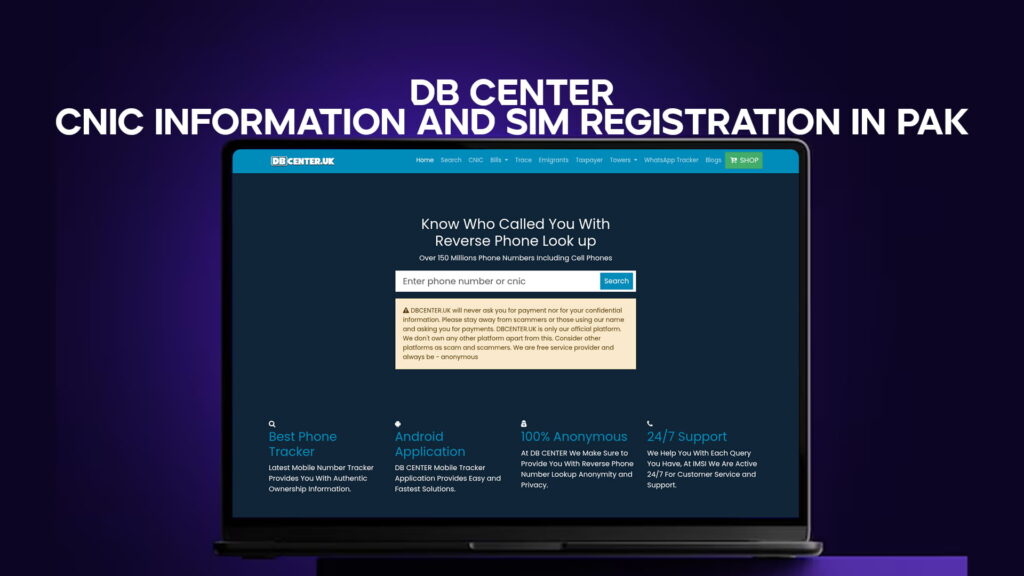
Most people have received a call from a number they did not recognize. Sometimes it is a wrong number. Sometimes it is a sales call. But sometimes it is something more concerning, a scammer, a harasser, or someone using a fake identity. In Pakistan, where every SIM card must be registered with a valid CNIC, there is a way to check. DB Center is the platform that makes that check possible.
DB Center is an online reverse phone lookup service with a database of over 150 million phone numbers, including cell phones. It is built to help users find out who is behind an unknown number. For people in Pakistan specifically, it connects SIM registration data to CNIC information, giving users a clear picture of who a number belongs to. It is fast, simple, and does not require any technical knowledge to use.
This article covers everything you need to know about CNIC information, SIM registration rules in Pakistan, and how DB Center helps you make sense of both.
Understanding CNIC in Pakistan
The Computerised National Identity Card, or CNIC, is the primary identity document issued to Pakistani citizens by NADRA (National Database and Registration Authority). It is a 13-digit number that is unique to every individual and is used across hundreds of official and unofficial processes in the country.
From opening a bank account to registering a vehicle, from filing taxes to applying for a government job, the CNIC is required at almost every step. It is the most basic proof of identity in Pakistan, and because it is tied to biometric data, it is considered a reliable form of verification.
When it comes to telecom services, the CNIC plays a central role. No one in Pakistan can legally purchase and activate a SIM card without providing their CNIC and going through a biometric verification process. This rule was put in place to make the telecom sector more accountable and to reduce crime involving mobile phones.
The result is a system where every active SIM in Pakistan should, in theory, be traceable back to a real person. DB Center uses data from this system to power its lookup service.
SIM Registration Rules in Pakistan
SIM registration in Pakistan is regulated by the Pakistan Telecommunication Authority, commonly known as the PTA. The PTA introduced mandatory SIM registration requirements to bring order and accountability to the mobile phone sector.
Under current rules, every SIM must be registered in the name of a real person using their CNIC and biometric fingerprint. Mobile operators are required to verify the identity of customers before activating any new SIM. Unregistered or illegally registered SIMs can be blocked by the PTA at any time.
There is also a limit on how many SIMs a single person can register. As of the most recent PTA guidelines, one individual CNIC can have a limited number of active SIMs across all networks combined. This cap was introduced because fraudsters and criminals were registering large numbers of SIMs under single identities, or using stolen or fake CNICs to avoid being traced.
Despite these rules, SIM fraud still happens. People sometimes obtain SIMs registered under someone else’s CNIC without their knowledge. This is why checking SIM registration details is not just a useful option for curious users. It is sometimes a necessary step for victims of identity theft or fraud.
Why People Check CNIC and SIM Information
There are several clear reasons why someone might want to verify CNIC or SIM registration data. None of them require unusual circumstances. These are everyday needs that affect ordinary people.
Receiving unknown or suspicious calls is the most common trigger. When a number you do not recognize calls you repeatedly, or when a call seems suspicious, knowing who owns that number helps you decide how to respond.
Checking if your CNIC has been misused is another important use case. Since SIMs can sometimes be registered using stolen identity information, checking which SIMs are tied to your CNIC is a responsible habit. If a SIM you did not register appears under your name, that is a clear sign of identity fraud.
Verifying someone’s identity before a financial transaction or business deal is also common. If a buyer, seller, or business contact provides you with a phone number, confirming that it is registered under the name they gave you adds a layer of protection.
Tracing harassment or threats is another reason. If someone is sending threatening messages or making harassing calls, identifying the number’s registered owner gives you something concrete to report to authorities.
Parents checking their children’s contacts use these tools to make sure their kids are not in contact with unknown adults. This is especially relevant for teenagers who may share their numbers widely.
In all of these cases, DB Center provides the lookup capability needed to get answers quickly.
How DB Center Connects SIM Data and CNIC Information
DB Center works as a reverse phone lookup engine. You enter a phone number, and the platform returns information tied to that number in its database. For Pakistani numbers, this information is drawn from SIM registration records, which include the registered owner’s name and CNIC details.
The database behind DB Center holds over 150 million phone numbers. This is not just a collection of landline records. It includes mobile and cell phone numbers, which is where most communication happens today. For users searching Pakistani mobile numbers, the database is especially relevant because it reflects the country’s SIM registration system.
When you run a search, the result typically tells you the name of the person the SIM is registered under, details connected to the CNIC tied to that SIM, the telecom network the number belongs to, and the general region associated with the registration.
This is a practical output. It gives you a starting point for verifying identity or deciding how to respond to an unknown contact. The search takes only a few seconds, and no account creation is needed for basic lookups.
How to Use DB Center for SIM and CNIC Lookup
The process of looking up a number on DB Center is designed to be as simple as possible. You do not need to be tech-savvy to use it. Here is how it works step by step.
Go to the DB Center website and locate the search bar on the homepage. It is usually the most visible element on the page, placed at the top or center.
Enter the phone number you want to search. For Pakistani numbers, include the country code. That means starting with +92, followed by the rest of the number. So a number like 0300-1234567 would be entered as +923001234567.
Click or tap the search button. The platform will scan its database and return any records it finds for that number.
Review the results. The output will show you the name and CNIC-linked information tied to that SIM registration. In some cases, you may also see the mobile network and registration region.
If no result appears, it may mean the number is not yet in the current database, or the SIM was recently issued or registered under unusual circumstances. The database is updated on a regular basis, so trying again after some time may yield results.
SIM Fraud and Why It Is a Real Problem in Pakistan
SIM fraud is more common than many people realize. It takes several forms, each with its own risks and consequences.
SIM swapping is when someone convinces a telecom operator to transfer your number to a new SIM they control. Once they have your number, they can intercept calls and messages, including OTPs (one-time passwords) used for banking and account verification. This type of fraud has been used to drain bank accounts.
Illegal SIM registration happens when someone uses a stolen CNIC or forged identity documents to register a SIM in another person’s name. The real CNIC holder never knows until something goes wrong. This can result in the victim being linked to criminal activity they had no part in.
Fake SIM sellers sometimes operate outside official channels and register SIMs using bulk CNICs. These SIMs then get used for spam, scam calls, or criminal communication.
Ghost SIMs are numbers registered under deceased individuals or people who never applied for a SIM. These are sometimes used in criminal networks because they are harder to trace.
Checking SIM registration through DB Center is one way to stay ahead of these threats. If you notice a SIM registered under your CNIC that you did not apply for, you can report it to your telecom provider and the PTA immediately.
Checking How Many SIMs Are Registered Against Your CNIC
One of the most important steps any Pakistani citizen can take is verifying how many SIMs are currently registered against their CNIC. The PTA provides an official channel for this, but many people are not aware of it.
You can send your CNIC number to 668 via SMS to get a list of all SIMs registered under your identity. If the number comes back with SIMs you do not recognize, that is a red flag.
DB Center complements this by letting you search specific numbers to confirm details about who they are registered to. Together, these tools give you a clearer picture of your telecom footprint and help you spot unauthorized registrations quickly.
If you find a SIM you did not register, the right steps are to contact your telecom provider and ask for that SIM to be blocked, file a complaint with the PTA through their official complaint portal, and consider filing a report with your local police, especially if the SIM has been used for fraud.
The Role of the PTA in SIM Registration
The Pakistan Telecommunication Authority is the government body responsible for overseeing all telecom activity in Pakistan. When it comes to SIM registration, the PTA plays a direct role in setting rules, enforcing them, and handling complaints.
The PTA regularly runs campaigns to block unregistered SIMs and crack down on illegal SIM sales. It works with mobile operators like Jazz, Telenor, Ufone, Zong, and SCO to make sure that every active SIM in the country is verified and registered correctly.
The PTA also runs awareness campaigns encouraging citizens to check their SIM registrations and report anything suspicious. If you believe your CNIC has been used to register SIMs without your consent, the PTA is the first official body to approach.
DB Center works alongside these official channels rather than replacing them. It is a quick first step. If what you find raises concerns, official channels are where you take it further.
Privacy Considerations When Using Lookup Tools
Using a reverse phone lookup tool raises a fair question: is this ethical? The answer depends on how the tool is used and where the data comes from.
DB Center uses data that comes from SIM registration records, which are tied to identity documents submitted voluntarily during the telecom activation process. This is not private data obtained through unauthorized access. It reflects the records that exist because of a legal requirement for SIM registration.
The purpose of using such a tool matters. Looking up an unknown number to protect yourself from fraud or harassment is a legitimate use. Using it to track, stalk, or harass someone is not, and may be illegal under Pakistani law and the cybercrime act.
DB Center provides a service that exists to help people protect themselves and verify information. Responsible use means using it for exactly that purpose, nothing more.
Why DB Center Is a Reliable Option
There are a handful of tools available that claim to offer phone number lookup services, but not all of them are reliable or well-maintained. DB Center stands out for a few clear reasons.
The database size is a major factor. With over 150 million numbers, including mobile and cell phones, the coverage is extensive. This increases the likelihood that any given Pakistani number will return a result.
The platform is regularly updated. Outdated databases are a common problem with lookup tools. DB Center works to keep its records current so that the information you get reflects real, up-to-date SIM registration data.
The user experience is clean and simple. There is no confusing interface, no unnecessary steps, and no requirement to create an account just to run a search. You can get results within seconds of loading the page.
For Pakistani users specifically, the inclusion of CNIC and SIM registration data makes it far more useful than generic global lookup tools that have no coverage of the Pakistani telecom system.
Final Thoughts
SIM registration in Pakistan exists for a reason. It creates accountability in the telecom sector and gives citizens and authorities a way to trace phone numbers back to real people. But the system only works if people know how to use the information it generates.
DB Center puts that information in your hands. Whether you want to find out who called you, check if your CNIC has been misused, verify a contact before a transaction, or trace a suspicious number, the platform gives you a fast and practical way to do it.
With a database covering over 150 million numbers and specific support for Pakistan’s SIM and CNIC registration system, it is a genuinely useful tool for everyday Pakistanis. Staying informed about who is contacting you and who is using your identity is not paranoia. It is common sense.
CNIC is a 13-digit national identity card issued by NADRA. In Pakistan, it is required for SIM registration so that every mobile number can be traced back to a verified individual, reducing fraud and criminal misuse of phone numbers.
You can send your CNIC number to 668 via SMS to receive a list of all SIMs registered under your identity across all networks. You can also use DB Center to search specific numbers and confirm their registration details.
Contact your mobile network provider immediately and request that the SIM be blocked. Then file a complaint with the PTA through their official portal and consider reporting the matter to local authorities if fraud is suspected.
Yes. When you search a Pakistani mobile number on DB Center, it returns the name and CNIC-linked information tied to that SIM registration, helping you identify who the number belongs to.
The PTA sets a limit on the number of SIMs a single CNIC can have active at one time across all networks. If you find more SIMs than you registered under your name, it may indicate unauthorized use of your identity.