
Pakistan is one of the fastest-growing digital countries in Asia. With more than 190 million active mobile subscriptions across the country, mobile phones have become an essential part of everyday life for almost every Pakistani citizen. From students and professionals to shopkeepers and farmers, nearly everyone uses a mobile phone today. However, this massive growth in mobile usage has also brought along a serious set of challenges that cannot be ignored.
One of the biggest problems that Pakistani citizens face today is the issue of unknown callers, SIM fraud, identity theft, and unauthorized SIM registration. Every single day, millions of people across Pakistan receive calls from numbers they do not recognize. Some of these calls are simple wrong numbers, but many of them are much more dangerous. Fraudsters, scammers, and criminals often use unregistered or illegally registered SIM cards to conduct their illegal activities. They call innocent people pretending to be bank officials, government workers, or prize distributors, and trick them into giving away their personal and financial information.
On top of this, there is a very common problem in Pakistan where someone registers a SIM card using another person’s CNIC without their knowledge or permission. This can happen through illegal SIM vendors, stolen identity documents, or biometric verification fraud. When this happens, the innocent person whose CNIC was misused can face serious legal and financial consequences without even knowing what happened.
This is exactly why the ability to search SIM ownership and CNIC information online has become so important for people across Pakistan. Being able to check which SIM cards are registered on your own CNIC, or being able to find out who owns a particular mobile number, is no longer just a convenience. It has become a necessity for personal security, financial safety, and identity protection.
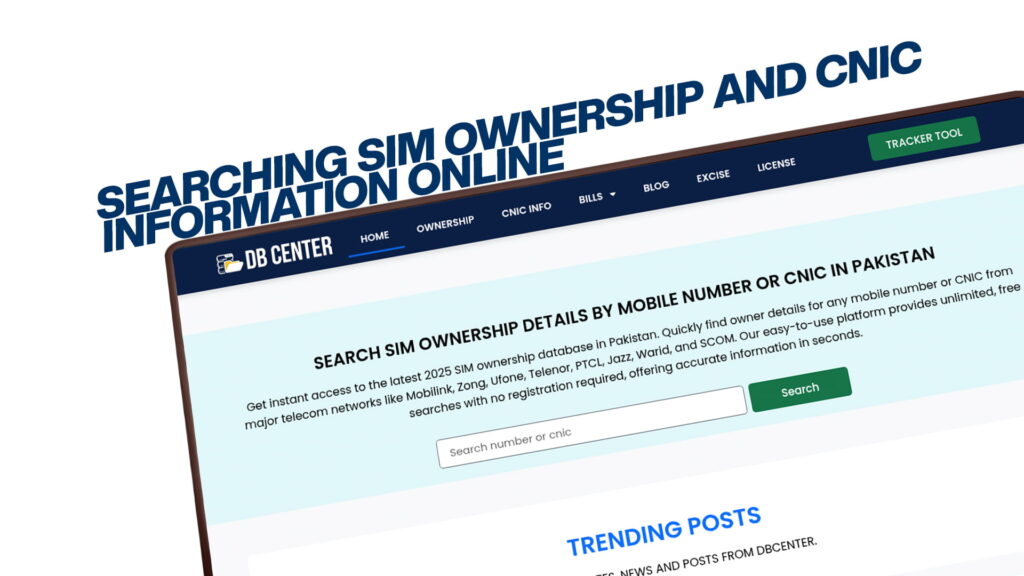
DB Center is one of the most powerful and comprehensive platforms available in Pakistan today that allows users to do exactly this. With instant access to the latest 2025 SIM ownership database, DB Center enables anyone to quickly find owner details for any mobile number or CNIC from all major telecom networks in Pakistan, including Mobilink, Zong, Ufone, Telenor, PTCL, Jazz, Warid, SCOM, and many more. In this article, we will explore everything you need to know about searching SIM ownership and CNIC information online in Pakistan, why it matters, how it works, and how DB Center helps you get the information you need in just a few seconds.
Understanding SIM Registration Rules in Pakistan
Before diving into how you can search for SIM ownership and CNIC information online, it is very important to understand the regulatory framework around SIM registration in Pakistan. The rules and regulations set by the government and Pakistan Telecommunication Authority (PTA) play a major role in shaping how SIM ownership data is managed and used across the country.
In Pakistan, every SIM card must be registered with a valid Computerized National Identity Card (CNIC) issued by NADRA (National Database and Registration Authority). This rule has been in place for many years, and it was introduced to make sure that every mobile number in the country can be traced back to a real, verified identity. The main purpose of this rule is to reduce crime, prevent illegal activities, and make it easier for law enforcement agencies to track down criminals who use mobile phones to conduct their operations.
The biometric verification system was introduced as an additional layer of security in Pakistan’s SIM registration process. Under this system, a person must physically verify their fingerprint at the time of purchasing a new SIM card. The fingerprint is matched against the NADRA database to confirm that the person presenting the CNIC is actually the real owner of that identity document. This system was designed to stop the practice of registering SIMs on stolen or forged CNICs.
Despite these strong measures, there have still been cases where SIM fraud and unauthorized registration has taken place. Some unscrupulous SIM vendors and telecom agents have found ways to bypass the system, and there have been reports of SIM cards being registered using the biometric data of unsuspecting people without their knowledge. This is a serious problem that affects ordinary citizens who have no idea that their CNIC is being misused.
Under PTA regulations, each CNIC in Pakistan is allowed to have a maximum number of SIM cards registered under it. The allowed limit may vary slightly between networks, but the general rule is that no single CNIC should have an excessive number of SIMs registered on it. If this limit is exceeded, the telecom company is required to block or deactivate the extra SIM cards. However, enforcement of this rule requires constant monitoring and verification, which is where online SIM database tools like DB Center become extremely valuable.
For ordinary citizens, understanding these rules means understanding their rights. You have the right to know how many SIM cards are registered on your CNIC. You have the right to report unauthorized SIM registrations and demand their cancellation. And you have the right to protect your identity from being misused by others. DB Center empowers citizens to exercise these rights easily and without any complicated process.
What Is DB Center and Why Is It Important?
DB Center is a leading online platform specifically designed to help Pakistani citizens search for SIM ownership and CNIC information quickly and easily. It is not just a simple search tool. It is a comprehensive digital resource that brings together data from all major telecom networks in Pakistan, giving users a single, unified platform to access the information they need.
The platform provides instant access to the latest 2025 SIM ownership database in Pakistan. This means that the information you find on DB Center is not old or outdated. It reflects the most current records available, making it one of the most reliable tools for SIM ownership verification in the country. The database is continuously updated to include new registrations and changes, ensuring that users always have access to accurate and fresh data.
What makes DB Center stand out from other similar platforms is its comprehensive coverage of Pakistan’s telecom landscape. Whether you are looking for information about a number from Mobilink, which is one of the oldest and most established telecom operators in Pakistan, or a newer network like Zong which is backed by China Mobile, or any other network like Ufone, Telenor, Jazz, Warid, PTCL, or SCOM, DB Center has all of them covered under a single platform. This means you do not need to visit multiple websites or contact multiple telecom companies to find the information you need. Everything is available in one place.
The importance of DB Center goes beyond just personal curiosity. It is a tool that serves a wide range of users with very different needs. Individual citizens use it to check their own CNIC records and protect their identity. Parents use it to monitor numbers that contact their children. Business owners use it to verify the identity of new clients or vendors. Security professionals and investigators use it to trace suspicious numbers. Even law enforcement agencies benefit from tools like DB Center that make it easier to identify and track down individuals involved in illegal activities through their mobile numbers.
DB Center is also important because it democratizes access to information. In the past, finding out who owned a particular mobile number or how many SIMs were registered on a CNIC required either a personal visit to a telecom office, filing a formal request, or knowing someone with access to internal records. This process was time-consuming, often expensive, and not always successful. DB Center changes all of this by putting the power of information directly in the hands of ordinary people. Anyone with internet access can now search for SIM ownership details in just a few seconds, from anywhere in the world.
How SIM Ownership Search Works on DB Center
The process of searching for SIM ownership and CNIC information on DB Center is designed to be as simple and straightforward as possible. The platform is built with a user-friendly interface that requires no technical knowledge or special skills. Whether you are using a smartphone, a tablet, or a desktop computer, the experience is smooth and easy to navigate.
When you visit DB Center, you are greeted with a clean and organized search interface. The platform typically offers two primary search modes. The first mode allows you to search by mobile number. In this case, you enter a specific Pakistani mobile number, and the system searches through its extensive database to find the ownership details associated with that number. The results will typically show you the name of the SIM owner, the CNIC linked to the SIM, and the telecom network to which the number belongs.
The second search mode allows you to search by CNIC number. This is particularly useful when you want to find out how many SIM cards are registered under a particular identity. When you enter a 13-digit CNIC number, the system searches for all mobile numbers that have been registered using that CNIC. The results give you a comprehensive overview of all the SIM cards linked to that identity, along with information about which telecom networks they belong to. This feature is especially valuable for people who want to check whether their own CNIC has been used to register any unauthorized SIM cards.
The technology behind DB Center’s search system involves a sophisticated database management process. The platform aggregates data from multiple sources and keeps it updated in line with the latest telecom records. When a search query is entered, the system cross-references the input against its database and retrieves the relevant records within seconds. The process is fast, reliable, and designed to handle a large number of simultaneous searches without any slowdown.
One of the key technical strengths of DB Center is its ability to handle variations in number formats. Pakistani mobile numbers can be written in different formats, such as 0300XXXXXXX, +923XXXXXXXXX, or 923XXXXXXXXX. DB Center is designed to recognize and process these different formats, reducing the chance of search errors due to formatting differences. Similarly, for CNIC searches, the system can handle numbers entered with or without dashes, making it more convenient for users.
The accuracy of the results provided by DB Center is one of its most important features. The platform uses its latest 2025 database, which means the records are current and reflect the most up-to-date registration information available. This is critically important because telecom records change constantly as new SIMs are registered, old ones are deactivated, and ownership transfers occur. An outdated database would produce inaccurate results that could mislead users. DB Center’s commitment to keeping its database updated ensures that the information you receive is as accurate and reliable as possible.
Why Searching SIM Ownership Online Matters for Every Pakistani Citizen
The ability to search SIM ownership and CNIC information online is not just useful for a specific group of people. It is relevant and important for virtually every citizen of Pakistan who owns a mobile phone or a CNIC, which is practically every adult in the country. The reasons for this are numerous and touch on several different aspects of daily life, personal security, and social responsibility.
Starting with personal identity protection, the threat of identity theft in Pakistan is very real. When someone else registers a SIM card using your CNIC, they can use that number to conduct all sorts of illegal activities. They can use it to make threatening calls, conduct financial fraud, communicate with criminal networks, or even carry out terrorist activities. If that number is ever traced, it will point back to you, the innocent CNIC holder, who had no idea what was happening. This can lead to serious legal trouble, damaged reputation, and enormous stress and difficulty. By regularly checking your CNIC on DB Center, you can catch this kind of fraud early and take action to protect yourself before things get out of hand.
From a financial security perspective, mobile numbers are increasingly linked to bank accounts, mobile wallets, and online payment systems in Pakistan. Apps like JazzCash, EasyPaisa, and various bank mobile apps are all connected to specific mobile numbers. If someone fraudulently registers a SIM on your CNIC and then links it to financial services, they could potentially access your financial accounts or set up new accounts in your name. Regular SIM ownership checks through DB Center give you an early warning system against this kind of financial identity fraud.
For families, especially parents, the ability to search SIM ownership details online provides an important layer of protection for children and young adults. Parents who receive complaints from their children about harassment calls or suspicious messages can use DB Center to quickly find out who is behind those numbers. This information can then be used to report the matter to school authorities, telecom companies, or law enforcement, providing a faster and more effective response to situations that might otherwise escalate.
For businesses operating in Pakistan, verifying the identity of clients, vendors, or employees through their mobile numbers has become a standard part of due diligence. When a new business partner contacts you from an unknown number, or when a vendor provides a contact number for their business, being able to verify that the number belongs to a real, registered individual adds a layer of trust and transparency to the business relationship. DB Center makes this kind of business verification quick and easy, saving time and reducing the risk of business fraud.
For people who buy and sell things online or through social media platforms, the risk of dealing with fraudsters is a daily concern. People who buy items through platforms like OLX or Facebook Marketplace in Pakistan are frequently targeted by scammers who use unregistered or fraudulently registered numbers to conduct fake transactions. Before sending money or goods to someone you have only contacted through a mobile number, checking that number on DB Center can give you valuable information about whether the person on the other end is who they claim to be.
From a broader social responsibility perspective, tools like DB Center also play a role in helping citizens contribute to the safety of their communities. When people have the ability to identify and report suspicious numbers, they become active participants in crime prevention. If a community is targeted by a series of fraudulent calls from the same number, community members who check and report that number through appropriate channels help authorities take faster action. This kind of collective participation in security is only possible when ordinary citizens have access to tools that give them meaningful information.
Major Telecom Networks Covered by DB Center
One of the most important aspects of any SIM ownership database platform is the breadth of its coverage. A platform that only covers one or two telecom networks is limited in its usefulness. DB Center distinguishes itself by providing comprehensive coverage of all major telecom networks operating in Pakistan, ensuring that users can find information regardless of which network a particular number belongs to.
Mobilink, which has been operating in Pakistan since 1994, is one of the country’s oldest and most established telecom providers. Over the decades, Mobilink has built up a massive subscriber base and remains one of the most widely used networks in Pakistan. The brand eventually merged with Warid Telecom and was rebranded as Jazz, though both names are still commonly referenced when discussing Pakistan’s telecom history. DB Center includes both Mobilink and Warid data in its database, ensuring that numbers from both of these networks can be searched and their ownership details retrieved.
Jazz, which emerged from the merger of Mobilink and Warid, is currently one of the largest mobile network operators in Pakistan. With tens of millions of active subscribers, Jazz numbers appear frequently in daily communications across the country. The Jazz network is particularly dominant in urban areas and among the younger generation of Pakistani mobile users. DB Center’s inclusion of Jazz in its database means that a huge portion of Pakistani mobile numbers can be searched through the platform.
Zong, which is operated by China Mobile Pakistan, is the country’s largest mobile data network by coverage. Known for its strong 4G LTE network and competitive data packages, Zong has grown rapidly over the past decade and now has one of the largest subscriber bases in the country. The network is particularly popular in smaller cities and rural areas where other networks may have limited coverage. DB Center includes Zong’s subscriber data, allowing users to search for ownership details of any Zong number.
Telenor Pakistan, a subsidiary of the Norwegian Telenor Group, is another major player in Pakistan’s telecom market. Telenor is known for its strong network coverage and innovative services, including its popular EasyPaisa mobile banking service. With millions of subscribers across the country, Telenor numbers are very common in everyday communications. DB Center’s coverage of Telenor ensures that users can find information about any Telenor number through a simple search.
Ufone, which stands for Uphone, is Pakistan’s government-backed mobile network operated by PTCL (Pakistan Telecommunication Company Limited). Ufone has been operating in Pakistan since 2001 and has built a loyal subscriber base, particularly in regions where government infrastructure is stronger. The network is known for its affordable call rates and strong coverage in southern Pakistan. DB Center includes Ufone subscriber data, making it possible to search for information about Ufone numbers as well.
PTCL itself, while primarily known as a landline and broadband internet provider, also has mobile subscribers through its various services. Including PTCL data in the DB Center database ensures that even fixed-line and PTCL mobile users can be searched through the platform.
SCOM, which operates primarily in the Sindh region of Pakistan, is a regional telecom operator that serves a significant number of subscribers in the south of the country. While SCOM may not have the national presence of the larger networks, it is an important operator in its coverage area, and its inclusion in DB Center’s database ensures comprehensive coverage of Pakistani telecom users regardless of where they are located.
The inclusion of all these networks in a single database is what makes DB Center such a powerful and useful tool. Users do not need to know which network a number belongs to before searching for it. They can simply enter the number or CNIC and let the platform find the relevant information from whichever network the number is registered with.
The Role of NADRA and PTA in SIM Registration and Verification
To fully understand how SIM ownership databases like the one maintained by DB Center work, it is helpful to understand the roles played by NADRA and PTA in Pakistan’s telecom identity verification system. These two government bodies are central to the entire process of SIM registration and ownership management in the country.
NADRA, the National Database and Registration Authority, is the government agency responsible for managing the national identity database in Pakistan. Every Pakistani citizen who holds a CNIC is registered in NADRA’s database, which contains their biometric information including fingerprints and facial recognition data, along with their personal details such as name, address, date of birth, and family information. When a new SIM card is to be registered in Pakistan, the telecom company must verify the identity of the buyer against the NADRA database using biometric authentication. This ensures that the person buying the SIM is who they claim to be.
PTA, the Pakistan Telecommunication Authority, is the regulatory body responsible for overseeing all telecom operations in Pakistan. PTA sets the rules and regulations that all telecom companies must follow, including the rules around SIM registration, subscriber data management, and the limits on how many SIMs can be registered per CNIC. PTA also maintains oversight of telecom data security and ensures that subscriber information is handled responsibly by all network operators.
The relationship between NADRA, PTA, and the telecom operators creates a comprehensive system for managing and verifying SIM ownership in Pakistan. However, this system also generates a large amount of data about subscriber identities and registrations, and making this data accessible to ordinary citizens in a useful and searchable format is exactly what platforms like DB Center are designed to do.
The existence of public-facing SIM ownership search tools reflects a broader global trend toward data transparency and citizen empowerment. In many countries around the world, there is growing recognition that citizens should have the right to access certain types of data about themselves and their digital identities. The ability to check what is registered under your own CNIC is a basic form of this right, and DB Center provides a practical way to exercise it.
Protecting Yourself from SIM Fraud and Identity Theft
One of the most important practical applications of DB Center is its role in helping Pakistani citizens protect themselves from SIM fraud and identity theft. These are serious crimes that can have devastating consequences for victims, and prevention through awareness and verification is always better than trying to deal with the aftermath of fraud.
SIM swapping is a particularly dangerous form of fraud that has become increasingly common in Pakistan and around the world. In a SIM swap attack, a criminal convinces a telecom operator to transfer a victim’s mobile number to a new SIM card that the criminal controls. Once they have control of the victim’s number, they can receive all SMS messages intended for the victim, including one-time passwords (OTPs) used for two-factor authentication on bank accounts and other sensitive platforms. This allows the criminal to bypass security measures and gain unauthorized access to the victim’s financial accounts.
By regularly monitoring your mobile number and CNIC details through DB Center, you can quickly detect if a SIM swap has occurred. If you notice a number associated with your CNIC that you did not register, or if your phone suddenly loses network signal for no apparent reason, these are warning signs that a SIM swap may have taken place. Immediate action, including contacting your telecom operator and filing a complaint with PTA, can minimize the damage.
Another common form of SIM-related fraud in Pakistan involves the registration of multiple SIMs on a single CNIC for the purpose of conducting scam operations. Criminal networks often acquire large numbers of SIM cards registered under different CNICs to use for mass fraud calling campaigns. Regular checks through DB Center can help identify if your CNIC has been used to register SIMs that you are not aware of.
Beyond SIM fraud, the broader issue of identity theft is something that every Pakistani citizen should be vigilant about. Your CNIC is your primary identity document, and if it falls into the wrong hands, it can be used for a wide range of fraudulent purposes beyond just SIM registration. Using DB Center to keep tabs on what is registered under your CNIC is one practical step in a broader strategy of identity protection that should also include keeping your CNIC physically secure, being cautious about sharing your CNIC number online, and regularly checking your financial accounts for unauthorized activity.
How Businesses and Professionals Benefit from SIM Ownership Search
While individual citizens are the primary users of SIM ownership search platforms like DB Center, businesses and professionals in Pakistan also derive significant benefits from having access to this kind of information. In a business environment where fraud, misrepresentation, and identity deception are genuine risks, the ability to quickly verify the identity behind a mobile number can be an invaluable tool.
For small and medium-sized businesses that conduct transactions through mobile communications, verifying that a contact number belongs to the person or entity it is claimed to belong to is an important step in due diligence. Before making a payment to a vendor, entering into a supply agreement, or hiring a freelancer, a quick SIM ownership check can confirm that the contact details provided are genuine. This is particularly relevant in industries like real estate, construction, retail, and online commerce where business is frequently conducted through mobile communications with parties who have not been met in person.
For human resources professionals and employers, checking the SIM ownership details of a job applicant’s provided contact number can be a useful part of the background verification process. While it is not a replacement for comprehensive background checks, it can quickly identify discrepancies between the name associated with a number and the name provided in a job application, which may warrant further investigation.
For lawyers, investigators, and legal professionals, access to SIM ownership information can be a critical resource in building cases, gathering evidence, or tracing individuals involved in legal disputes. When a client receives harassing or threatening messages from an unknown number, the ability to quickly identify the owner of that number through DB Center can provide valuable information that supports legal action.
For journalists and media professionals in Pakistan who are investigating cases of fraud, corruption, or criminal activity, being able to trace the ownership of a phone number used by a suspect or source can be an important investigative tool. While professional investigations may also involve formal requests to telecom operators and law enforcement, having quick access to basic ownership information through a platform like DB Center can help journalists confirm leads and focus their investigations more effectively.
For financial institutions and mobile banking operators, SIM ownership verification is a key component of the Know Your Customer (KYC) process. Confirming that a mobile number is registered to the same person as a bank account or mobile wallet is an important fraud prevention measure. DB Center’s comprehensive database makes it easier for financial institutions to perform these kinds of checks quickly and accurately.
Tips for Getting the Best Results from DB Center
Using DB Center effectively requires some understanding of how to enter search queries correctly and how to interpret the results. Here are some detailed tips that will help you get the most accurate and useful results every time you use the platform.
When searching by mobile number, always make sure you are entering the number in the correct format. In Pakistan, mobile numbers are typically 11 digits long, starting with a zero (for example, 0300XXXXXXX). When entering the number, you can also use the international format starting with the country code +92 or 92, followed by the 10-digit number (for example, +923XXXXXXXXX or 923XXXXXXXXX). DB Center is designed to handle both formats, but entering the number correctly reduces the chance of getting no results or incorrect results.
When searching by CNIC number, enter all 13 digits of the CNIC. The standard format for a Pakistani CNIC is XXXXX-XXXXXXX-X, but you can usually enter the number with or without dashes and the system will process it correctly. Make sure there are no extra spaces or characters in the input field, as this can cause the search to fail.
If your first search does not return results, try again with a slightly different format. Sometimes a number entered in one format may not match the database entry if it was originally stored in a different format. Trying the international format if you initially used the local format, or vice versa, can sometimes produce results that were not found on the first attempt.
Pay attention to the details shown in the results. DB Center typically shows not just the owner’s name and CNIC, but also the telecom network associated with the number. This can help you verify that you are looking at the right record, especially if you searched by CNIC and are reviewing a list of multiple numbers.
If you find information that appears to be outdated or incorrect, remember that database records are updated regularly and discrepancies can sometimes occur during the update process. If you are certain that a record is wrong, you can contact DB Center to report the discrepancy.
Use the search results responsibly. The information you find on DB Center should be used for legitimate, legal purposes only. Using someone else’s personal information for harassment, stalking, fraud, or any other illegal activity is a serious criminal offense under Pakistani law and can result in severe legal consequences.
The Future of SIM Ownership Verification in Pakistan
The landscape of telecom and digital identity verification in Pakistan is evolving rapidly. As the country moves deeper into the digital age, the importance of robust, accurate, and accessible SIM ownership verification systems will only continue to grow. Platforms like DB Center are at the forefront of this evolution, providing citizens with the tools they need to navigate an increasingly complex digital environment.
Looking ahead, there are several developments that are likely to shape the future of SIM ownership verification in Pakistan. One of the most significant is the ongoing rollout of 5G technology in the country. As 5G networks expand and more users migrate to faster, more connected mobile services, the volume of SIM registrations and mobile data will increase substantially. This will require even more sophisticated database management and verification systems to keep pace with the growth.
Another important development is the increasing integration of mobile identity with digital financial services in Pakistan. The rapid growth of mobile banking, digital wallets, and fintech platforms has made the mobile number a central pillar of financial identity for millions of Pakistanis. As this integration deepens, the importance of ensuring that mobile numbers are correctly registered and not being misused for financial fraud will become even greater. SIM ownership verification platforms will play a crucial role in this ecosystem.
The government’s ongoing efforts to digitize public services and expand the use of digital identity across different sectors will also increase the importance of SIM ownership data. As more government services become linked to mobile numbers and CNIC data, the need for accurate, up-to-date ownership records becomes critical for both individuals and institutions.
DB Center is well-positioned to remain a leading platform in this evolving landscape. Its commitment to maintaining the latest database, covering all major telecom networks, and providing a user-friendly search experience makes it a trusted resource that millions of Pakistani citizens can rely on as the digital environment continues to change and grow.
You can check all SIM cards registered on your CNIC by visiting DB Center. Simply open the platform, go to the search section, enter your 13-digit CNIC number in the search bar, and click the search button. Within a few seconds, the system will display a complete list of all mobile numbers that have been registered under your CNIC, along with information about which telecom network each number belongs to, such as Jazz, Zong, Telenor, Ufone, or any other major Pakistani network. This is the fastest and most convenient way to verify your SIM registration status without visiting any telecom office or making any phone calls. It is strongly recommended that every Pakistani citizen checks their CNIC registration regularly to ensure that no unauthorized SIM cards have been registered in their name without their knowledge or consent.
Yes, absolutely. DB Center allows you to search for the ownership details of any unknown mobile number in Pakistan. All you need to do is visit the platform, enter the unknown number in the search field using the standard Pakistani format such as 0300XXXXXXX or the international format +923XXXXXXXXX, and click search. The system will search through its extensive and updated 2025 SIM ownership database and return the relevant ownership details associated with that number. This includes the registered owner’s name, the CNIC linked to the number, and the telecom network to which it belongs. This feature is extremely useful for identifying suspicious callers, verifying the identity of business contacts, protecting yourself from scammers, or simply finding out who has been trying to reach you from an unfamiliar number.
Searching for SIM ownership and CNIC information online for legitimate and personal purposes is widely practiced in Pakistan and is used by millions of citizens to protect their identities and verify unknown callers. DB Center provides this service to help ordinary people access information that is important for their personal security and safety. However, it is very important to understand that the information retrieved through any SIM ownership search must only be used for lawful and ethical purposes. Using someone else’s personal information to harass, stalk, threaten, or defraud them is a serious criminal offense under Pakistani law, including the Prevention of Electronic Crimes Act (PECA) 2016, and can result in heavy fines and imprisonment. Always use SIM ownership information responsibly and within the boundaries of the law.
DB Center covers all major telecom networks operating in Pakistan within its comprehensive SIM ownership database. This includes Mobilink, Jazz, Zong, Telenor, Ufone, Warid, PTCL, and SCOM, as well as several other operators. This wide coverage means that regardless of which network a mobile number belongs to, you are very likely to find its ownership details through a simple search on DB Center. The database is continuously updated with the latest 2025 records, ensuring that the information available reflects the most current registration data across all supported networks. This makes DB Center one of the most complete and reliable SIM ownership search platforms available to Pakistani citizens, covering tens of millions of subscriber records from across the entire country.
If you discover through a DB Center search that an unauthorized SIM card has been registered on your CNIC without your knowledge or permission, you should take immediate action to protect yourself. The first step is to contact the telecom company whose network the unauthorized SIM belongs to and report the issue directly to their customer service team, requesting that the SIM be blocked and deactivated as soon as possible. At the same time, you should visit your nearest NADRA office and file a formal complaint about the unauthorized use of your CNIC for SIM registration. You should also file a complaint with PTA, the Pakistan Telecommunication Authority, through their official complaint portal or helpline, as PTA has the authority to investigate SIM registration violations and take action against telecom operators or vendors who are found to be involved in fraudulent registrations. If you believe you have been the victim of identity theft or fraud, it is also advisable to file a report with the Federal Investigation Agency (FIA) Cybercrime Wing, which handles digital identity crimes in Pakistan. Acting quickly is the most important thing you can do to minimize the damage and prevent the unauthorized SIM from being used for further illegal activities in your name.
Conclusion: Empowering Citizens Through Information Access
The ability to search SIM ownership and CNIC information online is one of the most practically useful digital tools available to Pakistani citizens today. In a country where mobile phone fraud, identity theft, and unauthorized SIM registration are ongoing challenges, having quick and reliable access to telecom ownership data is not a luxury but a necessity.
DB Center stands out as the most comprehensive and reliable platform for SIM ownership and CNIC information search in Pakistan. With its latest 2025 database covering millions of telecom subscribers across all major networks including Mobilink, Jazz, Zong, Telenor, Ufone, Warid, PTCL, and SCOM, it provides users with the information they need to protect their identities, verify unknown callers, secure their financial accounts, and contribute to the safety of their communities.
Whether you are an individual checking your own CNIC for unauthorized SIM registrations, a parent protecting your family from suspicious callers, a business owner verifying a new contact, or a professional conducting due diligence, DB Center provides the fast, accurate, and easy-to-use search experience that makes the process simple and effective.
The power of information is one of the most important tools in the fight against fraud and crime. When citizens have access to accurate information about the mobile identities around them, they are better equipped to protect themselves and others. DB Center is committed to providing that access, empowering millions of Pakistani citizens to take control of their digital identities and navigate the mobile landscape with confidence and safety.
In an age where digital identity is increasingly central to every aspect of life, platforms like DB Center are not just useful tools. They are essential infrastructure for a safer, more transparent, and more informed society. By making SIM ownership and CNIC information searchable and accessible to ordinary citizens, DB Center is playing an important role in building that infrastructure for Pakistan’s digital future.